Deployment blueprint

Six cleaning modes, one contract-scoring model

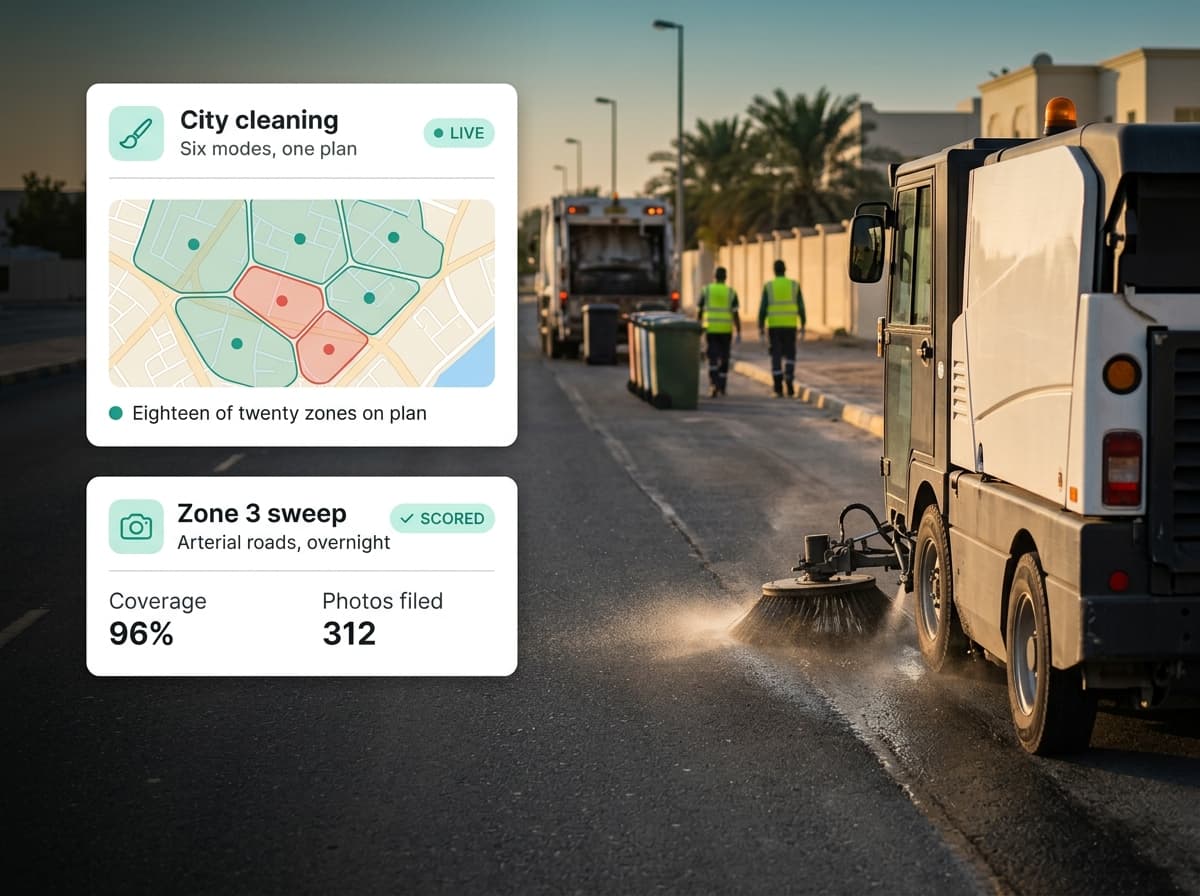
Mechanical sweepers run arterial roads at night. Litter pickers cover parks by day. Shoreline crews follow the tide. Each mode has its own labour model, tooling, and way of going wrong — and each has to be scored against the same contract framework.

  • Mechanical and manual crews
  • Geo-located work plans
  • Before/after photo evidence
  • Attendance without tablets
Municipal cleaning crew working on a city street

Built for this scale

6 modes
Mechanical to shoreline on one model
Sweeping, shoreline, manual litter picking, villa-area maintenance, underpass washing, and bulky-waste collection without flattening what makes each different.
Per obligation
Scoring tied to the contract clause
KPI evaluation runs against the specific commitment in each agreement, which is what makes a penalty calculation defensible.
Right device
Instrumentation that fits the worker
Vehicle telematics for machine crews; shift-transport attendance and wearables for manual crews who cannot carry a tablet.
Every shift
Continuous EHS evidence
Safety evidence is produced as work happens rather than assembled into an audit pack afterwards.

The challenges

What operators are up against

Each cleaning mode matured separately, under its own contractors, tooling, and KPIs. Standardising them naively breaks the ones that were working.

Challenge

Modes that refuse to standardise

Mechanical, manual, shoreline, villa, underpass, and bulky-waste grew up under different operating philosophies and contract structures. Some have decent telemetry; some still run on radios and paper. A single process imposed across all six degrades the mature ones without fixing the weak ones.
Challenge

Manual crews cannot carry fleet hardware

A litter picker walking a park for eight hours will not carry the terminal a sweeper driver has bolted to a dashboard. Any attempt to measure manual work has to meet it where it physically is, or the data quietly stops arriving.

Challenge

KPI scoring without usable evidence

Plan-versus-actual has to be computed against very specific obligations per contract, and the result has to survive a contractor's challenge. Scoring that cannot be traced to evidence becomes a number nobody is willing to apply a penalty to.

Challenge

EHS across roads, parks, and coastline at once

Crews work in traffic, in public parks, and on shorelines on the same day, under a strict safety regime. Periodic audits cannot demonstrate compliance for shifts that already happened without a record made at the time.

How it would work

How we would set this up

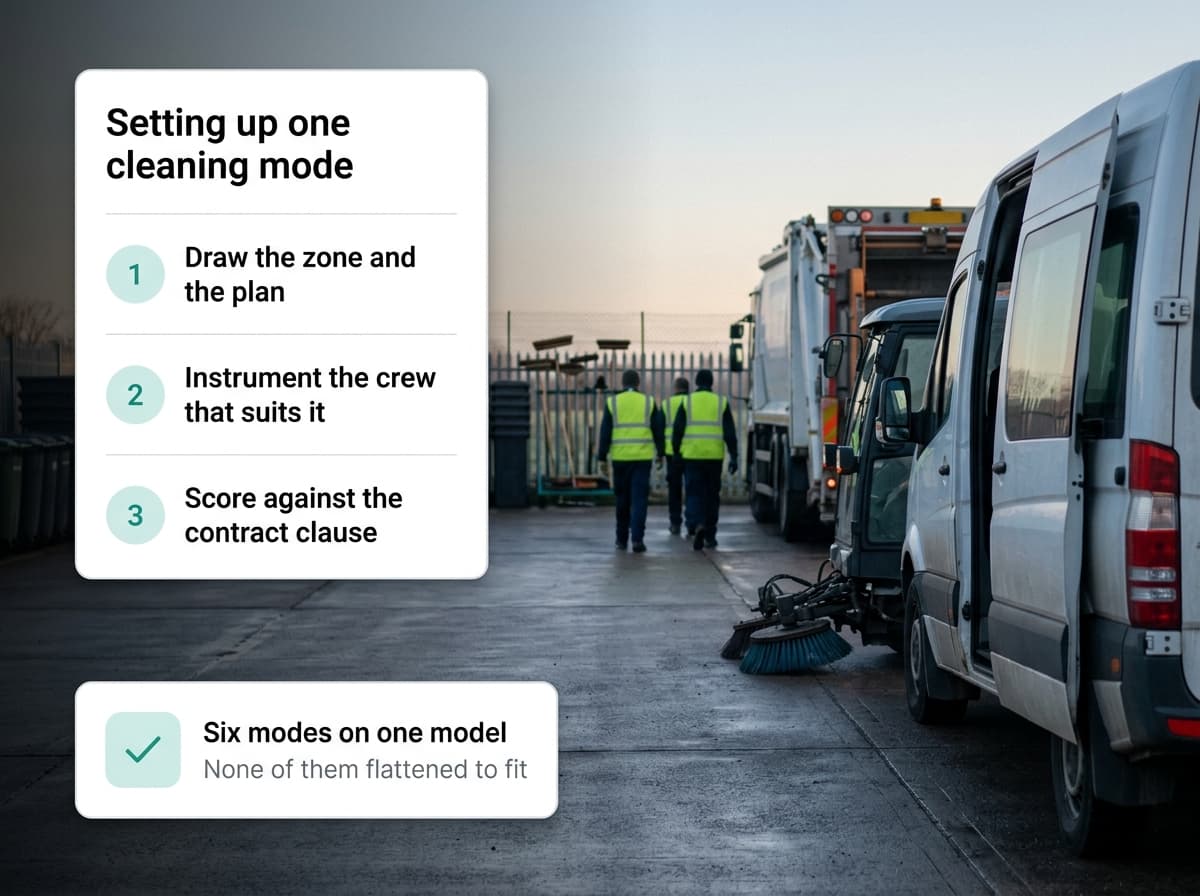
Monthly work plans are authored against contracts, geo-located, and approved before crews go out. Each mode is then instrumented with whatever actually fits it: CAN-bus telematics on sweepers and bulky-waste vehicles, attendance capture on shift transport for manual crews, wearables where a tablet is not realistic, and rugged devices for supervisors and inspectors. Tasks are assigned dynamically by zone and priority, and inspection captures geotagged before-and-after photographs against the obligation they evidence.

The architectural point

All six modes attach to one data model, one penalty matrix, one safety framework, and one workforce backbone — without being forced into one process. That distinction is the whole design: shared scoring and evidence structure, mode-specific execution. Adding a seventh cleaning activity or a new service provider becomes configuration against the existing model rather than another parallel system to maintain and reconcile.

pulse.app/cleaning

Crews on shift

284

Zones covered

76%

Open findings

42

EHS flags

3

Cleaning operations · shift view

live
  • Mechanical sweeping · night route

    22 units · arterial roads · on plan

  • Shoreline crew · attendance short

    9 of 14 registered at zone

  • Underpass washing · re-inspection

    Before/after photos required

Zone coverage % · last 12 days

Illustrative console view — sample data, not a live operation.

Platform capabilities

What gets deployed

Contracts, workforce, safety, asset lifecycle, and inspection running on one operating model.

Module

Contract scoring with penalty matrix

Geo-located work-plan automation across mechanical and manual cleaning, with KPI evaluation and penalty calculation tied to the contractual obligation itself.

Module

Workforce and supervisor apps

Attendance capture, supervisor tooling, and wearable tracking with dynamic task assignment by zone and priority — designed for manual labour rather than adapted from a fleet app.

Explore
Module

Inspection and incident management

Geotagged before-and-after photographs, custom checklists, alarm validation, and geo-located inspections, each linked to the obligation it evidences.

Explore
Module

Continuous EHS evidence

Safety practice recorded shift by shift across road, park, and shoreline environments, so the audit trail exists before the audit is announced.

Module

Maintenance and asset lifecycle

Usage-driven service schedules and asset lifecycle tracking keep sweepers and washing units available when the contract requires them.

Explore
Module

KPI dashboards

Centralised reporting that turns shift-level operational data into the evidence base for renewal decisions and process change.

Hardware in the field

What goes on the asset

Each mode gets instrumentation that suits it — vehicle, manual crew, or shoreline team — all resolving into one picture.

Municipal Cleaning Services Platform — equipment in the field
Device

Telematics on sweepers and bulky-waste vehicles

CAN-bus position, behaviour, and engine data across the mechanical fleet, device-agnostic across suppliers.

Explore
Device

Onboard weighing

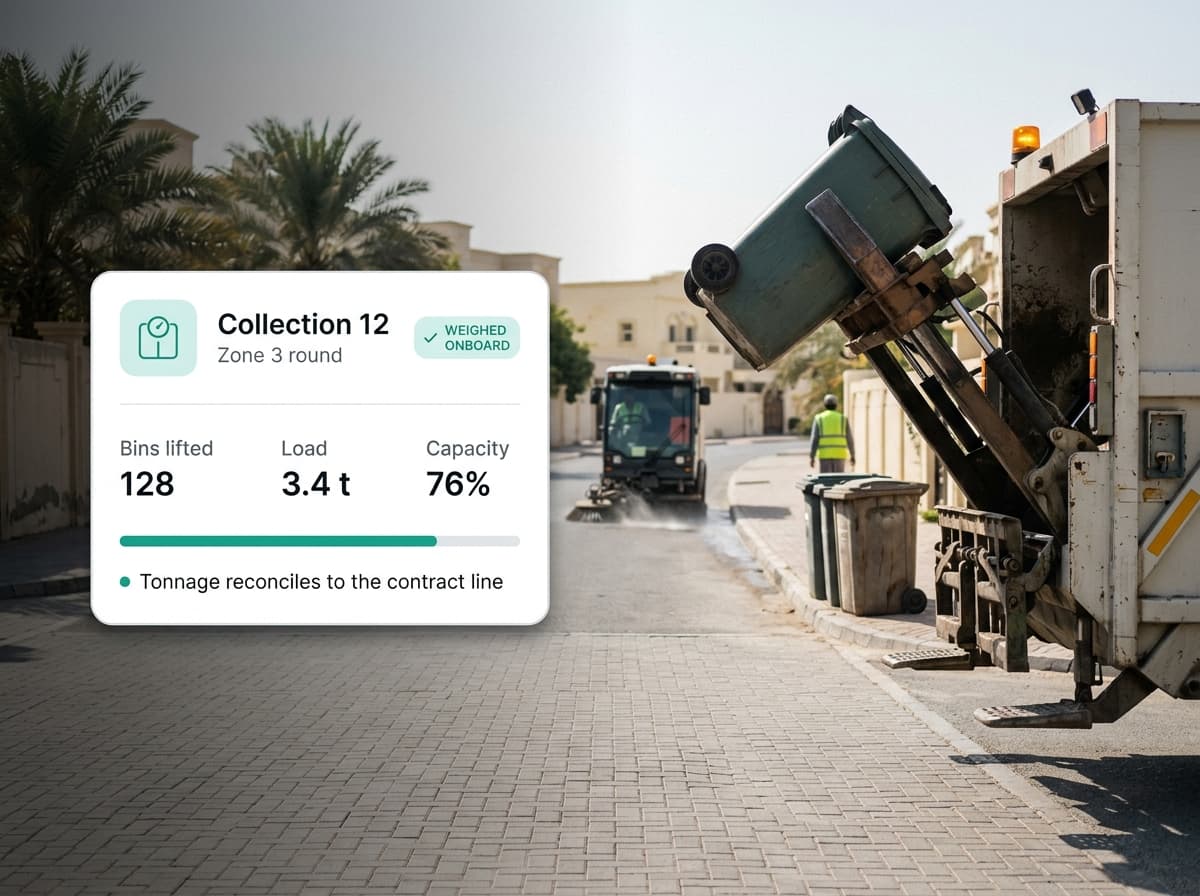
Bulky-waste vehicles weigh their own load, so the collected tonnage reconciles to the contracted line item without a separate weighbridge step.

Device

Attendance capture on shift transport

Sweepers and litter pickers register attendance where they already gather — on the vehicle that brings them to the zone — making manual crews a measurable cohort without unwearable devices.

Device

Wearable trackers

Selected manual roles use wrist-worn devices for location and task confirmation, enabling zone-based assignment without tablet-class hardware.

Explore
Device

Supervisor and inspector tablets

Rugged devices running supervisor and inspection apps for geotagged evidence, alarm validation, and custom checklists.

Explore

Integrations

Connected to what you already run

Connected to the department's HR, finance, and safety reporting systems, and to each provider's existing stack.

  • HR and finance

    Attendance, payroll inputs, and contractor finance flow into the department's systems so operational and administrative records agree.

  • EHS reporting and audit

    Safety evidence feeds statutory reporting continuously rather than being reconstructed for each audit cycle.

  • Provider-side systems

    Existing contractor telematics, apps, and operational tooling integrate vendor-independently, so a new provider does not trigger a rebuild.

  • Identity provider and SSO

    Department staff, provider users, and field inspectors authenticate against the existing directory with scoped permissions.

FAQ

Questions we get asked first

Short answers here — the detailed version is a conversation whenever you're ready.

Discuss your deployment

Ready to deploy at your scale?

Sovereign-data-friendly. Enterprise multi-org architecture. Built to integrate with the devices, SIM providers, and back-office systems you already run.

Real-time GPS · sub-1s latency12+ fleet analytics modulesMulti-org · white-label readyOn-premise deployment option