Deployment blueprint

Dispatch by remaining capacity, not just by who's nearest

Where there is no continuous sewerage network, tankering is the network. A late tanker floods a basement; a half-full one burns fuel that the next call needed. We give dispatch live position and live tank level, so the assignment fits the vehicle that can actually complete it.

  • Live tank-level telemetry
  • Capacity-aware assignment
  • Authorised-discharge proof
  • Resident ordering app
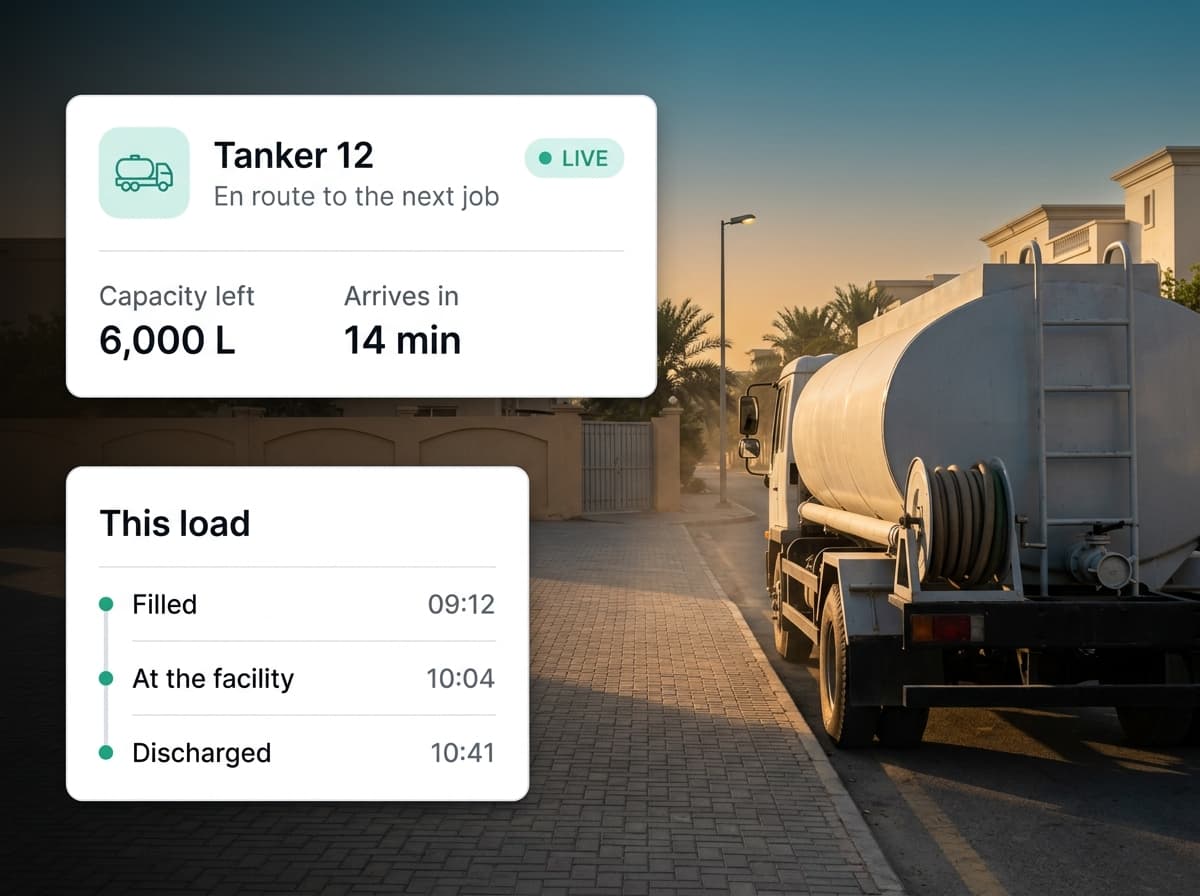
Tanker vehicle on an arterial road at dusk

Built for this scale

Two modes
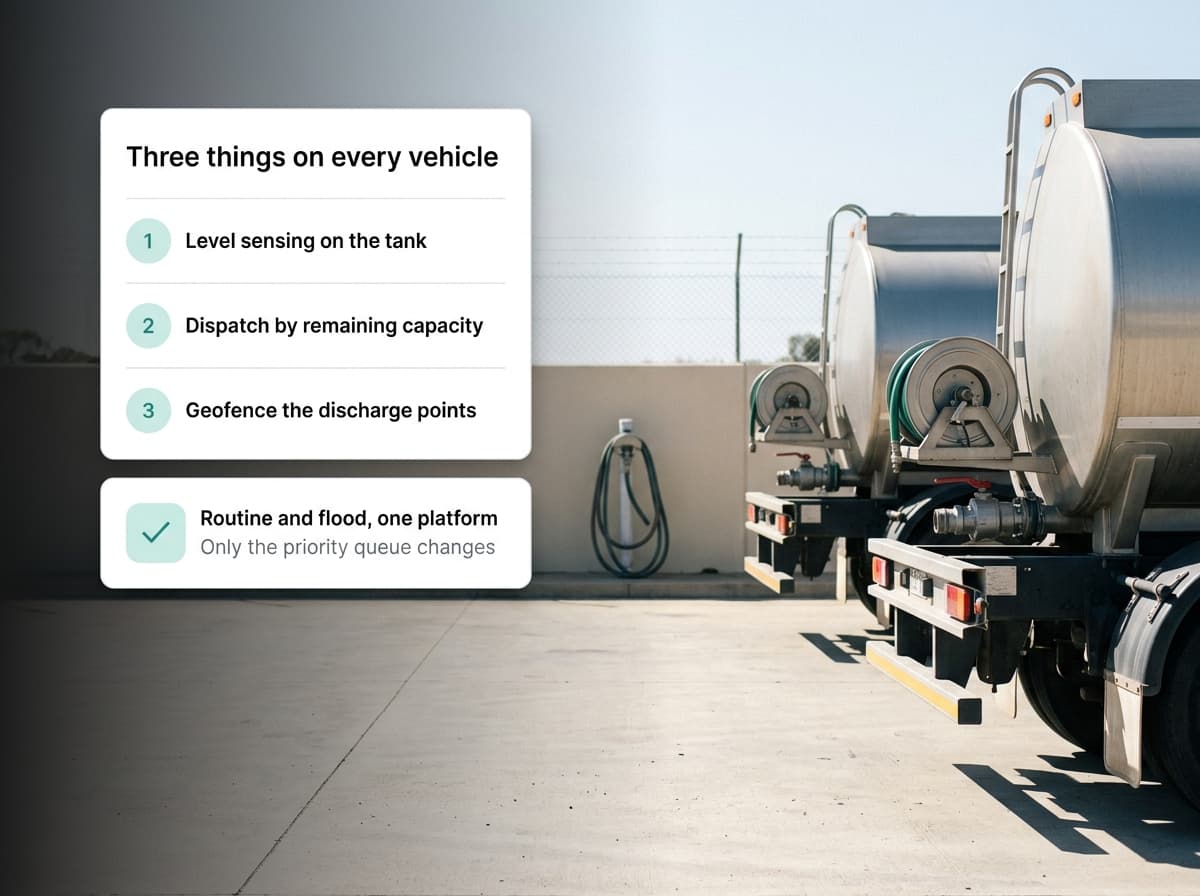
Routine and emergency on one platform
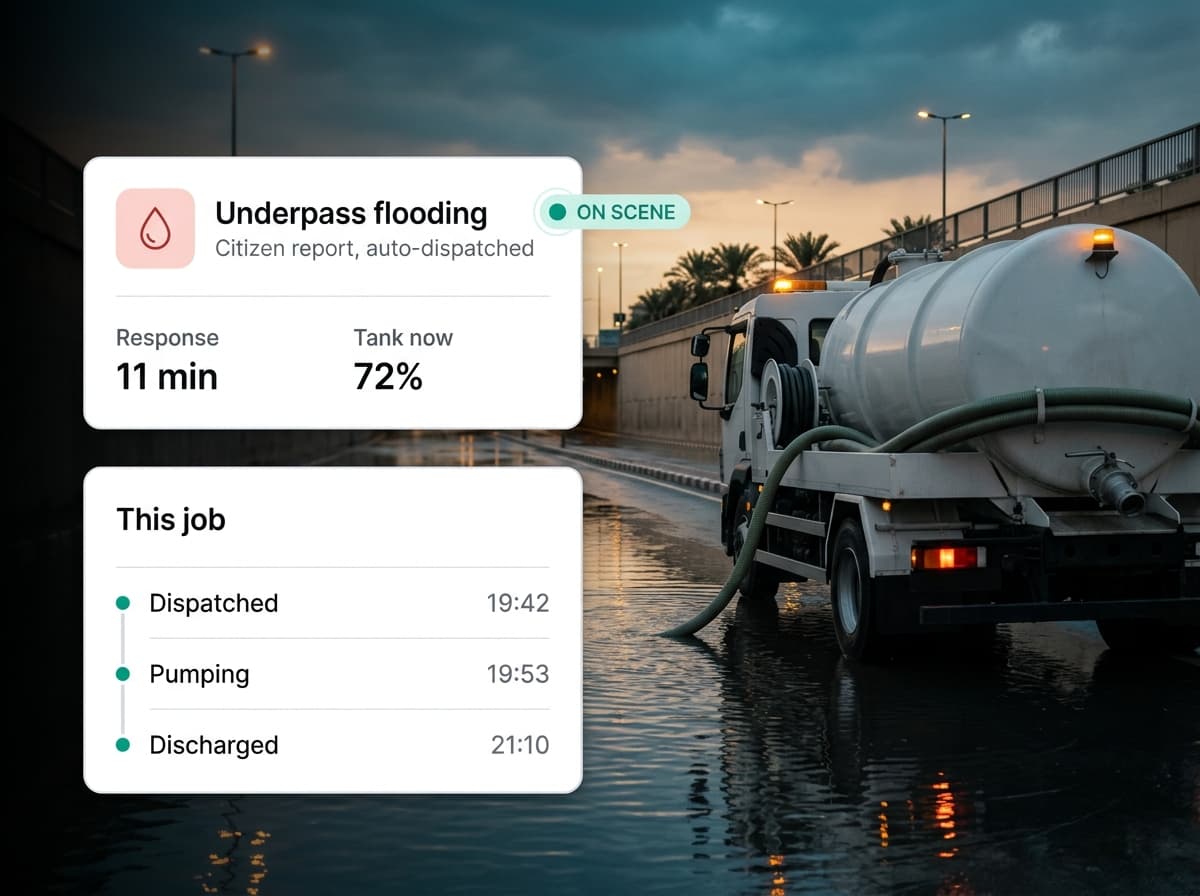
The same drivers, devices, dispatchers, and map handle a quiet weekday and a flood weekend. Only the priority queue changes.
Level + position
Capacity known before assigning
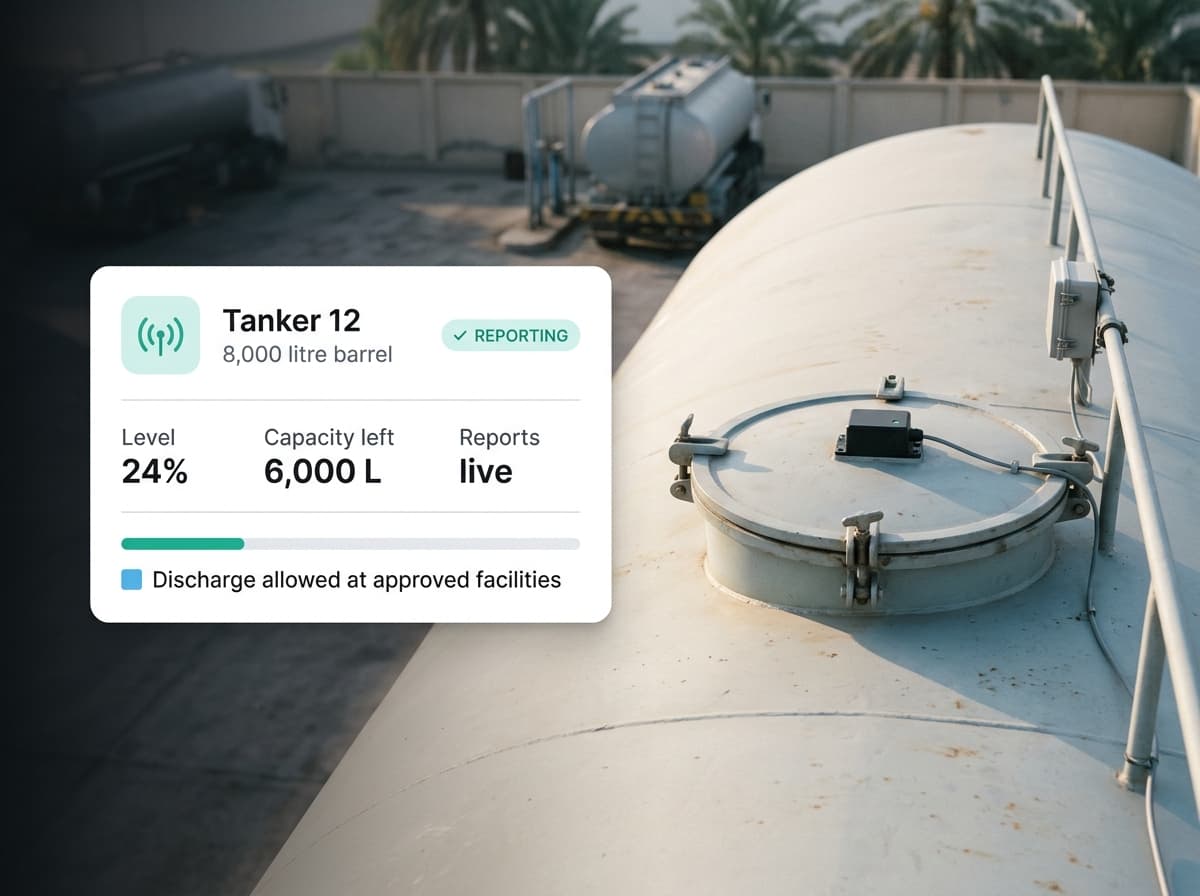
Radar or ultrasonic level sensors mean dispatch sees remaining capacity, not just the nearest vehicle on the map.
Geofenced
Discharge only at authorised facilities
Every emptying event is checked against approved facility geometry, producing an audit trail as a by-product of operating.
Self-service
Ordering without the call centre
Residents and commercial customers book, track, and pay in an app, so peak demand does not become a phone queue.

The challenges

What operators are up against

Demand is spiky, geography is unforgiving, and the regulator wants proof of where every load ended up.

Challenge

Manual routing collapses at peak

A planner working from a wall map produces allocations that are merely plausible — longer journeys, more fuel, uneven workload. On a religious holiday or during heavy rain, when volume multiplies, the method stops working altogether.

Challenge

Dispatch knows the plan, not the position

Controllers can see where a tanker was supposed to be. A breakdown, a long queue at the facility, or a driver taking a different route only becomes visible when the customer rings to ask why nobody has arrived.

Challenge

Discharge compliance rests on a logbook

Proving to an environmental regulator that every load reached an authorised facility on time is hard enough with paper records. Preventing an in-transit discharge before it happens is impossible with them.

Challenge

A customer experience nobody can staff

With no digital channel, every request, chase, and payment goes through the call centre. It holds on an average Tuesday and fails exactly when demand peaks, which is when community patience is thinnest.

How it would work

How we would set this up

The workflow runs from the resident's request to the authorised discharge. A customer app takes the order, shows an ETA, keeps the history, and handles payment. Incoming orders become dispatch candidates sequenced by proximity, tank capacity, current fill level, and the location of the approved disposal site — and re-sequenced continuously as breakdowns, delays, and new orders arrive. Level sensors and telematics mean the controller is choosing between vehicles on what they can still carry, not just where they are.

The architectural point

The decision that carries the most weight is treating routine tankering and emergency response as two modes of one platform rather than two systems. Same crews, same in-cab devices, same dispatch desk, same operational picture; what changes when a storm lands is the priority queue and the reporting cadence. That is why the operation pivots into flood response over a weekend without standing up a parallel command structure — the alternative is training people on a second system they will only use under maximum stress.

pulse.app/tankering

Available

146

Open orders

289

Near capacity

31

Discharge alerts

2

Tanker dispatch · live

live
  • Order #40218 · assigned

    Tanker 512 · 62% capacity · ETA 24 min

  • Tanker 337 · full, en route to facility

    Al Warqa disposal · 6.2 km

  • Off-route discharge attempt

    Tanker 209 · outside authorised zone

Discharges completed · last 12 days

Illustrative console view — sample data, not a live operation.

Platform capabilities

What gets deployed

Resident ordering, capacity-aware dispatch, live monitoring, and discharge enforcement on one stack.

Module

Live dispatch picture

Where every tanker is, how much capacity it has left, which exceptions are open, and what the next best assignment would be — on one screen.

Explore
Module

Capacity-aware routing

Assignment sequenced by proximity, tank capacity, current level, and authorised disposal point, re-planning as the queue changes rather than at shift start.

Explore
Module

Authorised-discharge enforcement

Approved facilities are geofenced; an off-route emptying attempt raises an exception with position and timestamps, leaving a clean trail for the regulator.

Explore
Module

Resident ordering app

Customers request a tanker the way they request a ride — address, time window, payment, history, live ETA, and recurring schedules.

Module

Analytics and customer records

Collection-volume trends, response times, and service history alongside the customer and billing record rather than in a separate reporting tool.

Module

Emergency mode

Routine queues hold, flood-response jobs take priority, and reporting switches to the cadence the authority needs while the event is still running.

Integrations

Connected to what you already run

Connected across the customer, financial, and regulatory boundaries, not only at the operations layer.

  • Billing and payments

    Balances, order history, and online payment reconcile with the existing back-office, so the app is a channel rather than a second ledger.

  • Environmental regulator reporting

    Discharge events, facility evidence, and severe-weather operations data export in the form the regulator asks for.

  • Identity provider and SSO

    Dispatcher and supervisor access follows the existing directory and organisational structure.

  • Municipal coordination

    In emergency mode, live vehicle positions and job status can be shared with municipal and civil-defence partners without duplicate data entry.

FAQ

Questions we get asked first

Short answers here — the detailed version is a conversation whenever you're ready.

Discuss your deployment

Ready to deploy at your scale?

Sovereign-data-friendly. Enterprise multi-org architecture. Built to integrate with the devices, SIM providers, and back-office systems you already run.

Real-time GPS · sub-1s latency12+ fleet analytics modulesMulti-org · white-label readyOn-premise deployment option