Deployment blueprint

From citizen call to nearest pump without a single phone tree

In a country built for dry weather, standing water becomes a public-safety hazard in minutes — and the authority usually does not own the trucks. We put contractor and subcontractor vehicles on one live picture and auto-dispatch the nearest available unit, on infrastructure you host yourself.

  • Nearest-available auto-dispatch
  • Contractor fleets on one map
  • Dispatch-to-completion timing
  • On-premise deployment option
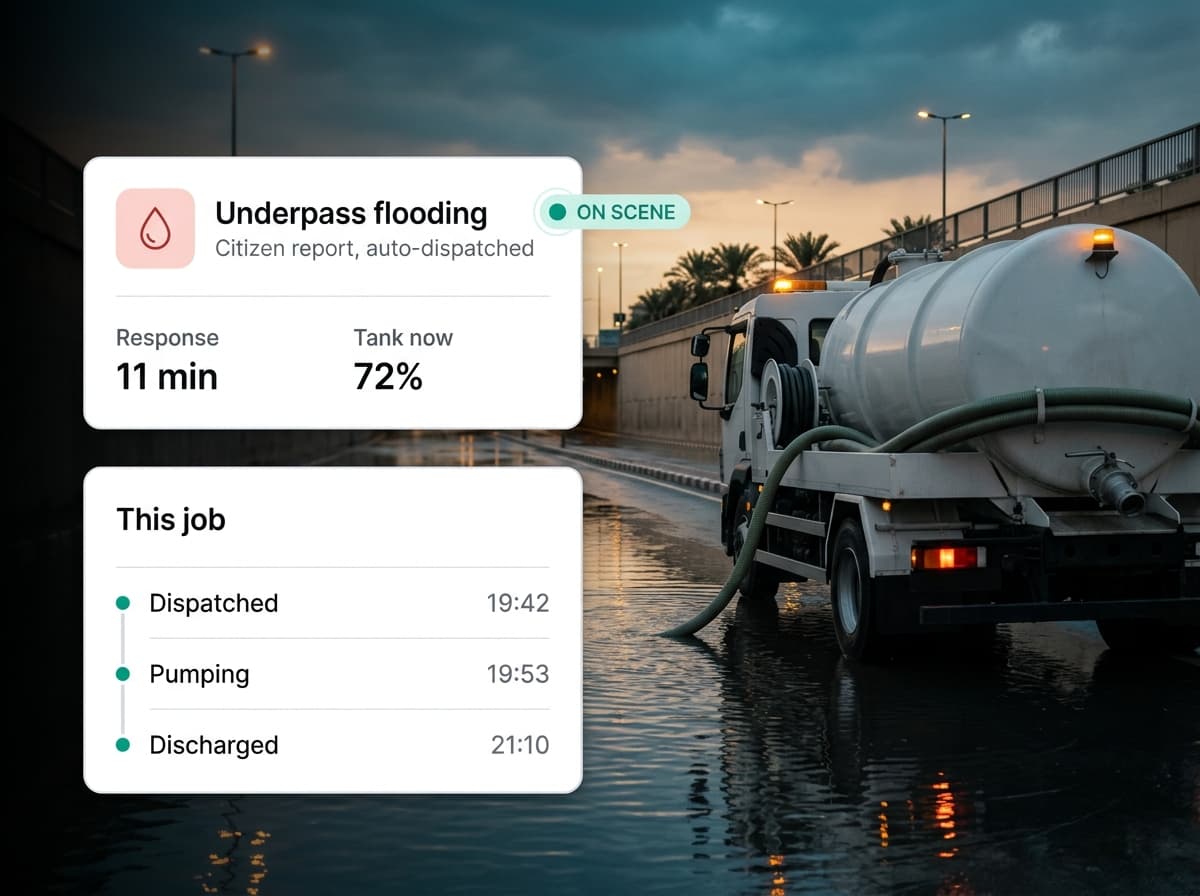
Heavy vehicle on a rain-soaked highway in poor visibility

Built for this scale

One hop
Request straight to vehicle
Auto-dispatch replaces the authority-to-contractor-to-driver call chain that costs minutes when minutes matter.
Mixed fleets
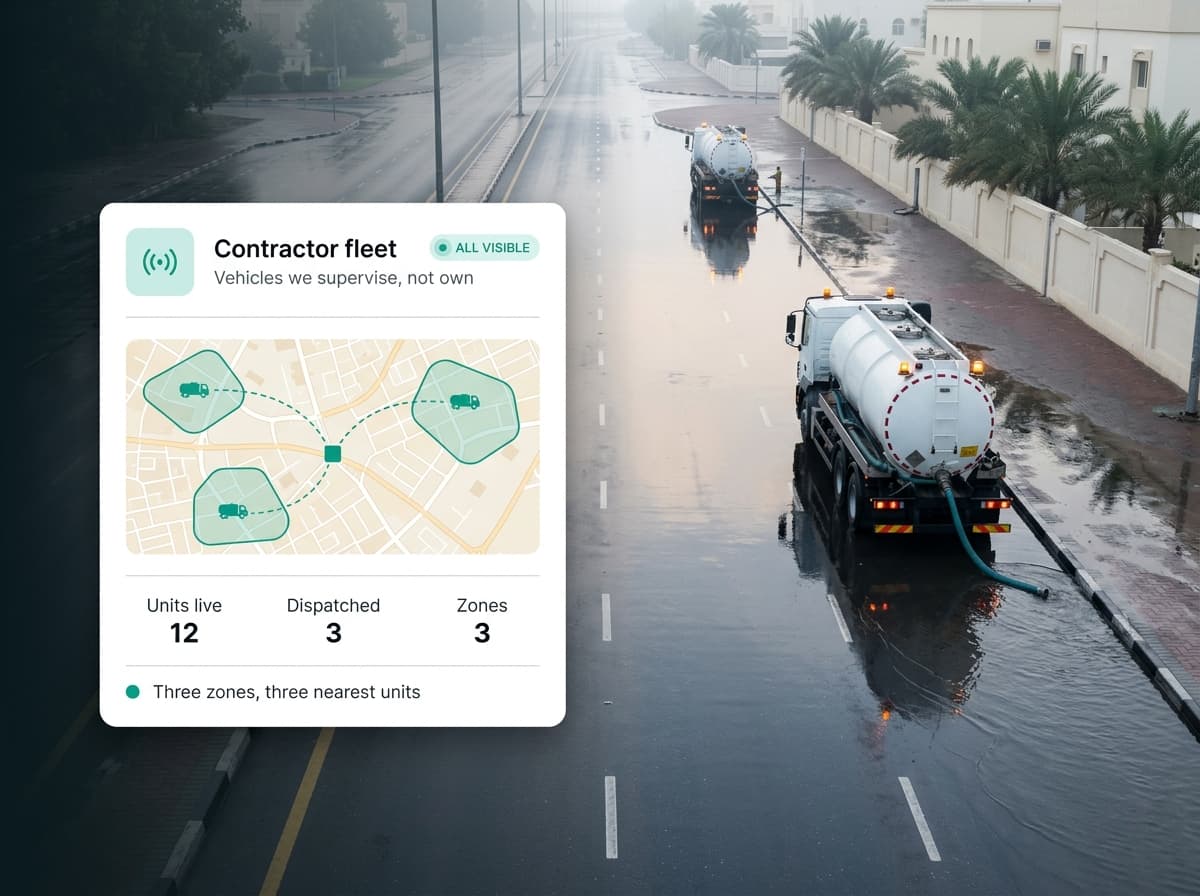
Contractors and subcontractors visible
Vehicles the authority does not own or operate appear on the same console, whatever hardware they arrived with.
Timestamped
Dispatch to completion on every job
Response and duration are recorded as the job runs, which is what makes payment evidence-based rather than negotiated.
On-premise
Sovereign hosting supported
Deployable inside the authority's own data centre for operations where data residency is not negotiable.

The challenges

What operators are up against

The rainy season is the hardest stretch of the operating year, and the response depends on fleets the authority supervises but does not run.

Challenge

The contractors' trucks are the blind spot

An operations centre can see the forecast, the incoming complaints, and eventually the invoices. What it cannot see is where the pump trucks currently are — so the flood response is coordinated on information that is already out of date.
Challenge

Dispatch by phone tree

Water accumulates, the authority calls the contractor to ask which unit is closest, the contractor calls the driver, and the centre waits for the callback. Each hop costs a few minutes; across a peak rainfall hour they add up to a response that arrives after the damage.

Challenge

Payment disputes from soft timings

Without dispatch and completion timestamps there is no way to check a contractor's claimed hours. Disputes accumulate, payment cycles stretch, and the contract review has no evidence to work from.

Challenge

Collected water goes wherever is quickest

Under emergency pressure, a crew with a full tank and no geofencing on approved disposal points will empty somewhere convenient. It is an environmental exposure the authority cannot quantify, so it cannot manage it.

How it would work

How we would set this up

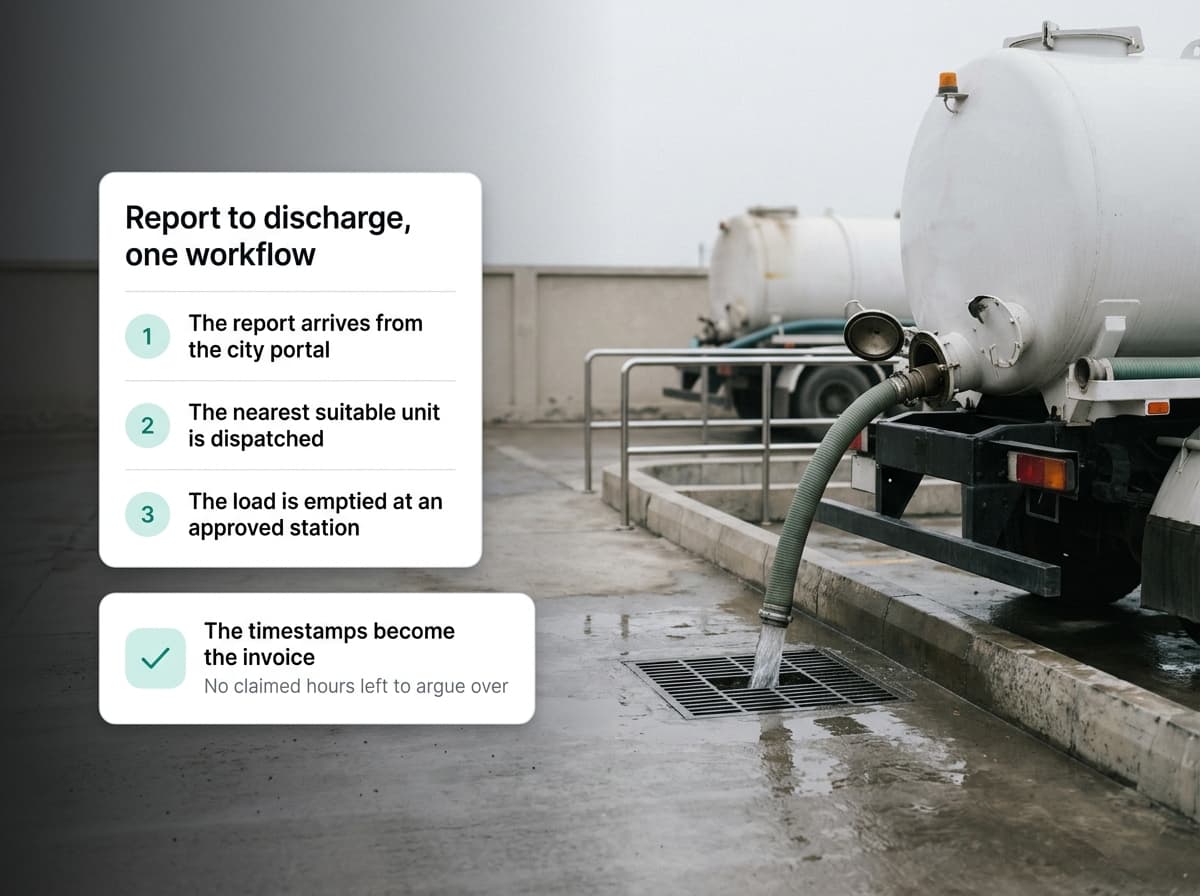
We deploy the dispatching platform where the authority needs it to sit — including entirely inside its own data centre — and cover contractor and subcontractor vehicles regardless of what hardware they already carry. Incoming requests are auto-dispatched to the nearest suitable unit with current workload, distance, and time-on-shift taken into account, so the allocation does not simply hammer whichever crew happens to be closest all night. Every incident records dispatch and completion times, and those timestamps are what the invoice is built from.

The architectural point

This is built for the emergency case first, with routine work treated as the quieter mode of the same system rather than the reverse. That matters because a platform tuned for normal conditions and stretched into a crisis fails at the moment it is needed most. Wiring it into the authority's citizen-facing request channel closes the loop: a public report becomes a dispatched vehicle and then a verified discharge, in one workflow, with no manual handoff in the middle.

pulse.app/flood-response

Open incidents

74

Units deployed

58

Avg. response

22 min

Awaiting unit

6

Rainwater response · active event

live
  • Underpass flooding · auto-dispatched

    Unit 44 · 1.8 km · accepted 09:12

  • Citizen report · queued

    Residential street · no unit within 12 km

  • Completed · discharge verified

    Unit 17 · authorised facility · 41 min

Incidents cleared · last 12 hours

Illustrative console view — sample data, not a live operation.

Platform capabilities

What gets deployed

Live monitoring, auto-dispatch, evidence-grade timing, and discharge control — deployable on infrastructure you own.

Module

Live monitoring across contractor fleets

Continuous visibility of contractor and subcontractor vehicles, task progress, and response times on one console — the phone tree replaced by a picture.

Explore
Module

Nearest-available auto-dispatch

Assignment to the nearest suitable unit accounting for current workload, proximity, and time-on-shift, so response is fast without burning out one crew.

Explore
Module

Authorised-discharge geofencing

Disposal points are geofenced and off-route emptying raises an exception — closing the illegal-discharge risk at source rather than at audit.

Explore
Module

Dispatch-to-completion timing

Every incident carries its own timestamps, turning contractor payment into an arithmetic exercise instead of a dispute.

Module

Citizen request channel integration

Public reports flow from the authority's existing service portal directly into the dispatch queue — one workflow from call to discharge.

Module

Sovereign on-premise deployment

Hardware, platform, and operator training delivered to run inside the authority's own data centre, for categories where external hosting is not an option.

Hardware in the field

What goes on the asset

Telematics across fleets you supervise but do not own, plus the infrastructure to run the platform yourself.

Integrations

Connected to what you already run

Connected to the citizen channel, finance, and inter-agency coordination while the platform itself stays where you put it.

  • Citizen service portal

    Flood-response requests arrive from the authority's public channel straight into dispatch, with no re-keying step in between.

  • ERP and finance

    Timestamps and discharge evidence flow into finance, so invoicing reconciles to the operational record by default.

  • Inter-agency coordination

    Live response status can be shared with municipalities and civil-defence partners during an event, without either side entering data twice.

  • Identity provider and SSO

    Authority and contractor users authenticate against the existing directory with role-scoped access, on-premise included.

FAQ

Questions we get asked first

Short answers here — the detailed version is a conversation whenever you're ready.

Discuss your deployment

Ready to deploy at your scale?

Sovereign-data-friendly. Enterprise multi-org architecture. Built to integrate with the devices, SIM providers, and back-office systems you already run.

Real-time GPS · sub-1s latency12+ fleet analytics modulesMulti-org · white-label readyOn-premise deployment option